

Society is too important to be left to adults
Mats Eriksson Dunér
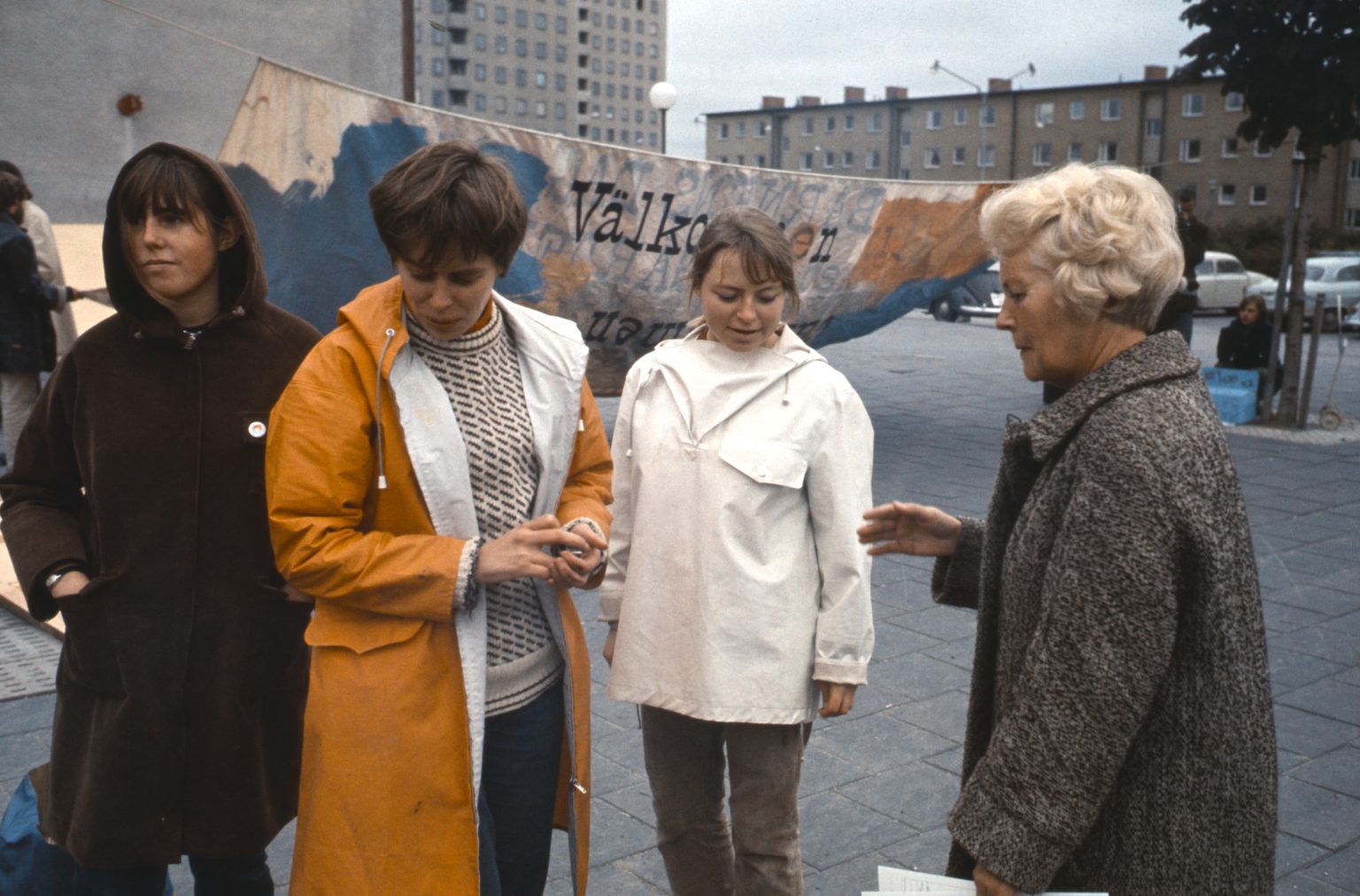
Gunilla Lundahl in an urban action event in Årsta, Stockholm (second from left).
Still from the film Aktivering Samtal (2020) by Mats Eriksson Dunér
Welcome to an event focusing on historical and contemporary efforts to grant children and young people the right—and the space—to participate in the development of our society and living environment. Featuring Gunilla Lundahl, Mats Eriksson Dunér, and Emílio Brandão, with an introduction and moderation by Magnus Ericson and Sara Brolund de Carvalho.
The program begins with a screening of the film Aktivering Samtal (Activation Conversation), a 2020 work by artist Mats Eriksson Dunér. The film centres on the activist group Aktion Samtal (Action Conversation) and explores the development of the project Modellen – En modell för ett kvalitativt samhälle (The Model – A Model for a Qualitative Society), which was carried out at Moderna Museet in 1968.
In the subsequent discussion, Mats and Gunilla Lundahl—who was active in Aktion Samtal – will talk about the group’s commitment to children’s rights within the city and society at large. Aktion Samtal was formed in the autumn of 1968 to intervene in the urban transformation then under way in Stockholm. United by a shared critique of the city’s failure to consider children, several groups joined forces to take action. Together, alongside Aktion Samtal, the groups occupied schoolyards, backyards, and communal neighbourhood spaces, thereby creating room and advocating for children’s right to play and recreation areas in public space. One of these actions served as the catalyst for the byalag (neighborhood association) movement. Another initiative took over Moderna Museet, aiming to draw attention to children’s creative play as a model for a “qualitative” society. [MY1] A further action targeted car culture, which restricts children’s freedom of movement. “You have to put all your energy into the children,” says Gunilla in an interview from that time—featured in the film—adding, “Adults are already ruined and indoctrinated.”
Following the discussion, architect, researcher, and educator Emílio Brandão will present his collaborative research work with the youth centre Mixgården in Hammarkullen, a neighbourhood in Gothenburg. For decades, the youth centre has developed an approach to their practice that extends far beyond simply offering leisure activities for young people. Rooted in an area shaped by a long history of migration, community organising, and territorial stigmatisation, they have developed a way of working centred on relationships, solidarity, participation, and community outreach. Through years of immersive research and teaching in the neighbourhood, Emílio has been engaged in listening to and learning from the stories, values and everyday practices that underpin this work. With solidarity at its core — and in opposition to conventional notions of youth work — a distinctive, relational approach to civic pedagogy emerges; building mutual trust, sharing responsibility, navigating conflicts, crossing social and cultural boundaries, and mobilising to stand up for others, both locally and globally. At Mixgården, solidarity is practised methodically and developed in dialogue with young people, through everyday activities that become opportunities for learning and participation.
Program
16:30 Screening of Mats Ericson Dunér’s film *Aktivering Samtal* (2020), 60 min
Break with refreshments
18:00 Introduction, conversation between Mats Ericson Dunér and Gunilla Lundahl, presentation by Emílio Brandão, and a conversation with Magnus Ericson and Sara Brolund de Carvalho.
Society is too important to be left to adults is part of a series of tributes to Gunilla Lundahl’s long-standing practice. At IASPIS, it is presented within the framework of Practice Matters – a project that explores design, architecture, and spatial practice, and their capacity to engage with urgent matters of crises and conflicts.
Gunilla Lundahl is a Swedish journalist, educator, curator, and activist. She served as an editor for magazines such as Form (1965–1969, and periodically throughout the 1970s and 80s) and ArkitektTidningen AT (1971, 1973–1977) and has authored numerous books. During the 1970s, she taught at Konstfack (University of Arts, Crafts and Design) and Teckningslärarinstitutet (the Institute for Art Teachers). Gunilla was involved in grassroots movements during the 1960s and 1970s – including Aktion Samtal – and served as one of the project leaders for Modellen – En modell för ett kvalitativt samhälle (The Model – A Model for a Qualitative Society) at Moderna Museet (1968). She developed the catalogues and publication series for the exhibitions ARARAT at Moderna Museet (1976) and Bo 1985. She has also conducted research projects, such as Big – det lilla kollektivhuset (1982). In 1993, she was awarded the Critics’ Prize by the Swedish Association of Architects.
Emilio Brandão is an architect, urbanist, researcher, and lecturer in design activism at Chalmers University of Technology in Gothenburg. He has served as the program director for the master’s program “Architecture and Planning Beyond Sustainability” at Chalmers. His research and teaching focus on urban pedagogies for social sustainability and inclusion, community resilience, and collaborative working methods. He possesses expertise in design activism, co-creation, participatory methods, and design processes and methodologies that involve a diverse range of stakeholders. He works in environments characterised by socioeconomic segregation.
Mats Eriksson Dunér is an artist and researcher based in Stockholm. In his artistic research, he examines self-organized collectives where children and adults during the 1960s and 70s used Stockholm’s public spaces as playgrounds. In the film Aktivering Samtal, we meet the artist group Aktion Samtal, who got involved in the urban planning and transformation of Stockholm. In the work around the Allaktivitetshuset Gamla Bro (1969–72), we meet activists, visitors and staff who talk about the struggle to establish an alternative social centre in Stockholm. Mats’s work takes its starting point from archive material, personal stories and the Swedish counterculture, in dialogue with the surrounding welfare state. He is currently starting a three-year research project with funding from the Swedish Research Council: “Parklek as a Model: Rewilding the Museum,” with the artists Camilla Carlsson and Gigi Argyropoulou.
Magnus Ericson is Head of Applied Arts, IASPIS, Sara Brolund de Carvalho is an architect and PhD student at KTH School of Architecture. Together with Mad Per Hasselberg, she invited Gunilla Lundahl to write “Children in the City – Is There Room for Them?” – a report on how society has historically viewed the needs of children in urban environments and what is required to protect children’s right to public space and play.