

Organising Infrastructures: Seizing the Means of Everyday Life
Welcome to a two day gathering bringing together cultural practitioners and organisations sharing knowledge and experience of organising otherwise through the means of aesthetics, spatial configurations and infrastructure.
What role might cultural houses and other urban commons have in times of increased financialisation and privatisation? When the present has given up on the future, what might we learn from the unactivated potentials in the futures of the past?
Participants include Marko Aksentijević (Ministry of Space, Belgrade), Beata Berggren & Martin Högström (Chateaux), Izabella Borzęcka (Folk i Skärholmen), Oda Brekke (Höjden Studios), Malte Dahlberg (Fylkingen), Viktor Eckert (Solidaritetshuset), Mariam Elnozahy (Konsthall C), Magnus Ericson (IASPIS), Sebastian Dahlqvist & Elof Hellström (Hägerstensåsens medborgarhus), Rotem Geffen, Adam Greenfield, Daniel Israelsson Casta (Vår lokal), İlksen Mavituna (Açık Radyo), Evelina Mohei (Cyklopen), Pedram Nasouri (Hägersten Sunrise), Damir Radovic (Det gror i betongen), Dubravka Sekulić (Royal College of Art, London), Nazem Tahvilzadeh (Södertörn University), Sofia Wiberg (KTH, Royal Institute of Technology) and Hedvig Wiezell (Folkets Husby).
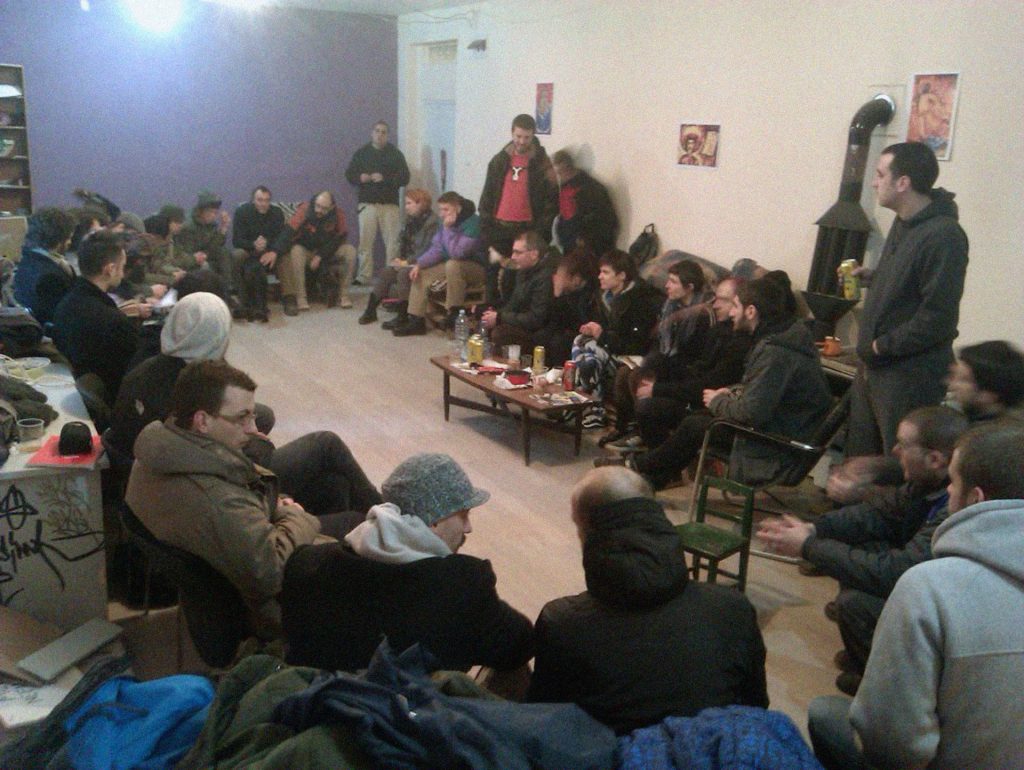
Photo: Ministry of Space
Weekly meeting of users of Inex Film, squatted social-cultural center in Belgrade, 2011-2015
The two-day event will draw from the history of community organising and discuss examples of present initiatives of different scales. It will look at different functions of these spaces, from hosting meetings and debate, pedagogy, publishing and archiving, to sports and leisure, and how these may contribute to other ways of imagining and organising together across different contexts and geographies. The programme includes historical perspectives from Sweden and former Yugoslavia, experience from local organisations as well as perspectives related to Turkey and the United Kingdom. Day one is organised around two sessions of presentations and discussions, day two is shaped as a reflection in the format of a live radio show.
Organising Infrastructures: Seizing the Means of Everyday Life is a collaboration between IASPIS, Hägerstensåsens Medborgarhus. The event is organised as part of Practice Matters, a project exploring design, craft, architecture, and spatial practice and its ability to act in relation to present urgent issues of crisis and conflicts. The project is developed in collaboration between IASPIS and Salt.
Programme
Tuesday 2 June
9:30 Welcome and Introduction by Magnus Ericson
09:45 One thousand houses of culture: seizing the means of recreation, with Sebastian Dahlqvist & Elof Hellström
By examining the history and current conditions of assembly halls, cultural centers, and community centers, this presentation explores the artistic and organizational strategies that can be used to democratize art, artistic production, and everyday life. What might a cultural center that corresponds to today’s social, political, and technological conditions look like? The presentation is based on their artistic research project Tusen Kulturhus (1000 Houses of culture), which includes a one-year post-master’s program at the Royal Academy of Fine Arts in Stockholm, several symposia, radio programs, exhibitions, and publications.
10:30 Break
10:45 With our ears to the ground, with Hedvig Wiezell
The community centre as a place for hyper-local learning and un-learning as its starting point for this presentation. Folkets Husby is a citizen-run meeting place of 700 square meters in the heart of Husby, has been run by a non-profit association since 2016, with the motto ”With our ears to the ground, gazing forward.” With a focus on culture, public education and community engagement based on the residents’ needs, they are an important meeting place in northwest Stockholm.
11:00 Conversation led by Nazem Tahvilzadeh
12:00 Lunch
Vegan lunch included for registered participants
The lunch is composed by Daniel Israelsson Casta (Vår lokal) based on Recept för hus och parker, Folkets Folkblad No 1, 2025 (Recipes for houses and parks from the newspaper Folkets Folkblad No 1, 2025)
13:00 An extensive network of infrastructure for collective life, with Marko Aksentijevic
Socialist Yugoslavia, like Sweden, built an extensive network of infrastructure for collective life: community halls, workers’ universities, youth clubs – spaces where people gathered, debated, learned, and organised. That infrastructure is now largely gone: abandoned, privatised, captured by political parties, or simply left to decay. This presentation explores what comes after, drawing on a recent mapping of over 50 independent socio-cultural centres and emerging initiatives across Serbia, as well as fifteen years of practice by the Belgrade-based collective Ministry of Space.
13:45 Conversations
14.30 Presentations by Evelina Mohei (Cyklopen), Damir Radovic (Det gror i betongen), Izabella Borzęcka (Folk i Skärholmen), Malte Dahlberg (Fylkingen), Oda Brekke (Höjden Studios), Mariam Elnozahy (Konsthall C), Viktor Eckert (Solidaritetshuset)
15:45 Break
16:00 Concluding conversation led by Sofia Wiberg
Wednesday 3 June
17.00-20.00 Hägersten Sunrise: Radio Bar
Live Host Pedram Nasouri concludes and expands the first day’s conversations. With essays, presentations, conversations and music by Marko Aksentijević (Ministry of Space, Belgrade), Beata Berggren & Martin Högström (Chateaux), Izabella Borzęcka (Folk i Skärholmen), Oda Brekke (Höjden Studios), Malte Dahlberg (Fylkingen), Viktor Eckert (Solidaritetshuset), Mariam Elnozahy (Konsthall C), Magnus Ericson (IASPIS), Sebastian Dahlqvist & Elof Hellström (Hägerstensåsens medborgarhus), Rotem Geffen, Adam Greenfield, Daniel Israelsson Casta (Vår lokal), İlksen Mavituna (Açık Radyo), Evelina Mohei (Cyklopen), Pedram Nasouri (Hägersten Sunrise), Damir Radovic (Det gror i betongen), Dubravka Sekulić (Royal College of Art, London), Nazem Tahvilzadeh (Södertörn University), Sofia Wiberg (KTH, Royal Institute of Technology) and Hedvig Wiezell (Folkets Husby).
Listen in on 88.9 MHz in south of Stockholm, radiosydvast.se or on site. Snacks and drinks will be provided!
The programme includes among many other things:
Dubravka Sekulić and Adam Greenfield in conversation while walking in North London
For those who live in cities, space is what enables (or prevents) them to gather, love, dream, desire, care for each other. In times of societal change and onset of climate breakdown that is already stretching capacity of existing spaces to support life, so many of previously existing community spaces have been decimated by the decades of privatisation, austerity and organized abandonment, where will we care for each other? In a conversation recorded while walking in North London, Dubravka Sekulić and Adam Greenfield attend to the city as a support system for everyday life, by discussing Lifehouse a proposal to claim spaces from below for communities to organize beyond bare survival?
Ilksen Mavituna introduces Istanbul based Açık Radyo
Açık Radyo (Open Radio), which went on air on November 13, 1995, is a “regional” radio station which broadcasts to the metropolitan Istanbul area and its environs on 95.0 FM and to the whole world via www.acikradyo.com.tr. They are not dependent on any interest group or any corporation and the station is devoted to the principles of pluralist democracy, the rule of law, and the protection and promotion of universal human rights and fundamental freedoms. Producer Ilksen Mavituna introduces the station and respond to questions of challenges and possibilities.
Live concert with Rotem Geffen
Rotem Geffen is the Stockholm-based singer, pianist, and composer Nelly Klayman-Cohen, using the moniker Rotem Geffen, conjures up a refined yet raw dream world with her music. With a nod towards a more reserved and minimal approach to lyricism, her clever delivery is amplified by more wistful inflections. She is keenly aware of the prismatic colorations of her voice and pushes her vocal timbres to distorted undulations. In lyrics that alternate between Hebrew, German and English, she works with fragments and memories.
Publication launch by CHATEAUX, Beata Berggren and Martin Högström
CHATEAUX presents the fifth title in the publishing series Bokbrev: Till pollen by the English poet J. H. Prynne, translated by Gustav Sjöberg. J. H. Prynne died on April 22 of this year but was long active in Cambridge and his innovative poetry has influenced a large number of English-language poets. Till pollen was originally published in 2006 and was written with the US and UK invasion of Iraq in mind, but its references to the horrors of war still appear sadly relevant today.
Hägersten Sunrise is a radio program broadcasted from Hägerstensåsens medborgarhus every Wednesday 08.00 at 88,9 MHz in south of Stockholm. The hosts consist of the working team from the house with the aim to give you an update on what’s happening in the building and the latest news from the southern suburbs. During the spring of 2026 they have amongst other things broadcasted live from the ghost station Kymlinge and the subway, interviewed graffiti writers, barrier guards and doormens as well as poets and graphic designers.
Participants and organisations
Açık Radyo (Open Radio), which went on air on November 13, 1995, is a “regional” radio station which broadcasts to the metropolitan Istanbul area and its environs on 95.0 FM and to the whole world via www.acikradyo.com.tr. They are not dependent on any interest group or any corporation and the station is devoted to the principles of pluralist democracy, the rule of law, and the protection and promotion of universal human rights and fundamental freedoms. Thus, it is a fiercely independent medium. It can be considered as one of those rare independent institutions in the Turkish media scene, which is under increasing pressure from both the state and from the concentration of ownership of financial and power centers.
Marko Aksentijević is based in Belgrade and his practice unfolds at the intersection of urban politics, cultural production and community building. Creating spaces — physical, social and symbolic — where people gather, make things together and organize has been at the core of his work for over fifteen years. This has taken many forms: co-founding the squat and social center Inex Film and the Street Gallery; organizing over a hundred editions of the spoken word festival Poetrying; and through Ministry of Space Collective, a Belgrade-based platform for democratic urban development he co-founded in 2011, engaging in local urban struggles, campaigns and advocacy on urban development, housing rights and spatial equality.
Izabella Borzecka works as a curator, editor and operations manager in Stockholm. Her interests include publishing practices, social choreographies and leadership as curatorial practice.
Oda Brekke, born in Bergen is a dance artist living in Stockholm. In her practice she takes on roles as choreographer, performer, dramaturge and writer. In 2019 Oda was part of co-founding the collective studio space höjden in Stockholm, a collegial platform and common resource for autonomous production and artistic exchange. She is interested in facilitating discursive frames within the expanded field of dance and choreography and has contributed to a variety of formats for conversation, artistic laboratories and study groups.
Cyklopen is a self-built and self-managed cultural and social space in Högdalen, Stockholm, that was inaugurated in 2013. The house is managed as an urban common, and strives for more democratic ways to share and distribute resources, space and knowledge.
Chateaux is a poetry publishing house based in Stockholm, runned by poets Beata Berggren and Martin Högström. In the Bokbrev publishing series, three poetry books are published each year and sent by post to the series’ subscribers. To subscribe for an annual subscription for 2026, email chateaux@hotmail.se.
Det gror i betongen is an association that strives to create contexts that feel meaningful to the young generations. Over the years, they have been committed to getting their own permanent place for cultivation and culture in the surrounding fields in Järva, and in Rinkeby they have a shiitake cultivation on oak logs. Through temporary infrastructures they also create meeting places and block parties to celebrate the harvest.
Viktor Eckert works as a coordinator for the umbrella association that manages Solidaritetshuset and, together with five other colleagues, he is responsible for the infrastructures of the house.
Mariam Elnozahy is Artistic Director of Konsthall C, Stockholm. She’s a curator, researcher and writer who has studied and worked in the USA, Egypt, Saudi Arabia, the Netherlands, Poland and the UK, among others. Elnozahy’s exhibition practice often highlights the relationship between material power relations and representation in art. An example of this is “All That Is Solid Melts Into Water: Hydropower, Archeology, Indigeneity,” which deals with hydropower and land rights in a Nordic context. “All That Is Solid Melts Into Water”, curated together with Rado Ištok, was shown in parallel at Oslo Kunsthall and Uppsala Art Museum.
Magnus Ericson is leading programmes related to design, crafts, architecture, and spatial practice at IASPIS in Stockholm. He is a Stockholm-based curator and educator. In different institutional settings and as an independent curator, he has combined curatorial and pedagogical practice with an emphasis on socially engaged critical practice, alternative pedagogies, and creating spaces for learning. He is the founder and co-curator of the IASPIS project Urgent Pedagogies and Practice Matters.
FOLK i Skärholmen is a non-profit association, operating as an independent cultural center and gathering place in Skärholmen. They believe in free, intergenerational meeting places where people can meet, network, create culture and develop together. They also run our own cultural activities, including SKHLM Konsthall with a local perspective in focus.
Folkets Husby is a citizen-driven meeting place of approximately 700 square meters in the heart of Husby, which has been run by the non-profit association of the same name since 2016. With a focus on culture, popular education and community engagement based on the needs of the residents.
Fylkingen is an artist-run, non-profit association for experimental music and art. It was founded in 1933, making it one of the world’s oldest forums of its kind. Today, the association consists of more than 100 active members who are developing and presenting new work across electro-acoustic and other forms of experimental music, dance, film, video, performance art and installations. It is run by an active board and programming group. In 2023 they relocated to a temporary location in Bredäng.
Sebastian Dahlqvist is the artistic director at Hägerstensåsens medborgarhus and an artist who in his practice often works with collective memory, urban and social space as well as historical material to confront that which underscores the present. During the last two decades his work has taken the form of exhibitions, theatre plays, publishing houses, temporary as well as long-term collectives, educational experiments such as the post-master course Tusen kulturhus at the Royal Institute of Art in Stockholm and various self-organized institutions. During the last decade he’s been part of establishing Den kollektiva hjärnan, a national network for self-organized and artist-run initiatives all over Sweden.
Rotem Geffen is the Stockholm-based singer, pianist, and composer Nelly Klayman-Cohen, using the moniker Rotem Geffen, conjures up a refined yet raw dream world with her music. With a nod towards a more reserved and minimal approach to lyricism, her clever delivery is amplified by more wistful inflections. She is keenly aware of the prismatic colorations of her voice and pushes her vocal timbres to distorted undulations. In lyrics that alternate between Hebrew, German and English, she works with fragments and memories.
Adam Greenfield is a London-based writer, and urbanist who has spent the past quarter-century thinking and working at the intersection of technology, design and politics with everyday life. He initiated and is the host of Lifepod, a podcast about taking care of ourselves in a world on fire. He is an author of several books, Lifehouse (Verso, 2024) and Radical Technologies (Verso, 2017), Against Smart City (Do Projects, 2013). He is a Visiting Professor at the London School of Economics.
Elof Hellström is artistic director of Hägerstensåsens medborgarhus in Stockholm and between 2023 – 2025 he was adjunct lecturer at Royal Institute of Art where he led the research-based course Tusen kulturhus. He is a co-founder of the transdisciplinary right-to-the-city collectives SIFAV (2012 – 2017) and Mapping the Unjust City (2015–2026), and for fifteen years he was also active in the self managed cultural house Cyklopen.
Hägerstensåsens medborgarhus is a cultural house, a people’s house and one of Stockholm’s largest meeting rooms. Open every day, for everyone. The house is a place for popular education, community organizing and culture. Every week, the house is used by thousands of individuals, associations and groups. It houses local radio, chess clubs and pensioners’ associations together with exhibitions, theatre plays, reading groups, artistic research and dance courses for both newborns and pensioners. The ambition is to create an ecosystem of social, artistic and pedagogical practices that enable conversations, reflection and a democratization of the local neighborhood and the city at large.
Höjden Studios is an artist-driven workspace featuring a studio, art studios, a gallery and offices – a space for freelance cultural workers, artists, and our audience to come together. Their goal is to contribute to a cultural scene that thrives with new initiatives and forms of expression, while advocating for collaboration and solidarity among artists and disciplines. They aim to strengthen the independence of the art field and create secure and sustainable conditions for cultural work by, for example, offering a continuous working environment, opportunities for presentation, an audience, and networks.
Daniel Israelsson Casta is a chef at Vår Lokal since 2018 and a former student of Tusen kulturhus at the Royal Institute of Art. He has focused on plant-based food for the past fifteen years and is passionate about festive everyday food with one leg in home cooking and the other in French cuisine. During the seminar he will make food from the recipes he made for Folkets Folkblad, a magazine that was produced for The Peoples Houses and Parks association meeting in the fall of 2025.
IASPIS is the Swedish Arts Grants Committee’s international Programme for Visual and Applied Arts. IASPIS’ programme includes residencies in Sweden and abroad, public programmes in Sweden and internationally, publications, expert visits, regional and international collaboration projects, and an archive.
Konsthall C is a public work of art, an urban renewal project and an art institution located in a former communal laundry in Hökarängen. Since the start in 2004, they have organized exhibitions and events based on the neighbourhood’s history and present, its people and its environment.
Pedram Nasouri is a teacher, DJ and private researcher in the psychohistory of disco, living in southern Stockholm. Pedram has previously been active in the self managed cultural center Cyklopen in Högdalen, and has organized parties there as well as in most of the city’s urban fringes. Pedram is also a resident DJ and co-organizer of People’s House and the morning club Babyrave at Hägerstensåsen’s citizens’ center. During the spring, he is also one of the radio hosts in Hägersten Sunrise, which is broadcast from 08.00 every Wednesday on 88.9 MHz.
MayDay Rooms is an archive, resource space and safe haven for social movements, experimental and marginal cultures and their histories. Their building in the centre of London contains an archive of historical material linked to social struggles, resistance campaigns, experimental culture, and the expression of marginalised and oppressed groups.
Evelina Mohei is a graphic designer based in Stockholm, Sweden. She has an interest in design within communal spaces, how they evolve over time through the influence of their users, but also which narratives are lost during renewal processes. She is part of the editorial team of the anarchist magazine Brand and is involved in running a printing house at the autonomous social center Cyklopen, alongside managing her own design practice.
Damir Radovic is an artist and cultural worker based in Järva, Stockholm. His artistic career began by combining slogans and graffiti, which was followed by carnivalesque antics, dance and street art, often outside traditional art contexts. In 2015, he founded the Det Gror i Betongen farming association, which has regularly organized harvest festivals with a street festival character in Hjulsta and Rinkeby.
Nazem Tavilzadeh is a researcher at Södertörn University. His research deals with critical perspectives on urban politics and administration in Swedish cities. He is in general concerned with issues of power, democracy and policy regarding contemporary urban development politics in cities. He has written about participatory governance, citizens’ participation, social movements and sustainable development policies in planning and the situation of exclusion and marginalisation in urban peripheries. A significant part of his research is conducted by ethnographic and co-productive methodologies together with social movements and with policy and planning administrators.
Lamya Sadiq is the Public Engagement Coordinator at MayDay Rooms Archive. She also works at Culture & and Hopscotch Women’s Center in London. She is interested in the ambivalences of the present; searching for ruptures, portals and hauntings that point to an otherwise and affirm revolutionary life. She is also a member of Red Therapy, an abolitionist collective attempting to think beyond psychiatric and psychotherapeutic systems and practices, and is a clinical trainee in psychoanalytic psychotherapy. Sadiq is from Dhaka, Bangladesh and based in London.
Solidaritetshuset is a self-managed association and cultural center on Södermalm in Stockholm. Since 1982, the meeting place has been home to around 50 associations that work with solidarity issues with different focuses in all corners of the world. Globally as well as locally. The building houses offices, meeting rooms, the World Library and a recording studio.
Dubravka Sekulić is an architect, theorist, educator and Programme lead for MA City Design, Royal College of Art in London, UK. Focused on issues of solidarity and liberation, her work explores the connection between spatial literacy and collective political emancipation. Her research explores transformations of contemporary cities, at the nexus between the production of space, laws, and economy. She holds a PhD from the Institute for History and Theory of Architecture, ETH Zurich (CH) on the relationship between the Yugoslav construction industry and the Non-aligned Movement. Author and editor of several books, she is currently writing a book entitled Minorplanning: Spatial Politics for Liberated Futures.
Vår lokal is a restaurant, a living room, an office, Peoples House and a non-profit association with a cultural scene in Gnesta, Stockholm.
Sofia Wiberg is a lecturer and researcher at KTH Royal Institute of Technology and Konstfack University of Arts, Crafts and Design in Stockholm. Her PhD thesis, Lyssnandets praktik – medborgardialog, icke-vetande och förskjutningar (The Practice of Listening – citizen dialogue, non-knowing and displacements), explores the political dimensions of listening within collaborative urban planning processes. Her research moves across the intersections of knowledge, practice and politics, with a particular focus on knowledge practices in collective forms of work and decision-making. At KTH she is the manager of Transplace, a practice-based research school exploring questions of transformation in urban planning. She is also one of the course leaders of Gestaltade livsmiljöer, gemensamma rum, interdisciplinära praktiker, a collaborative course between Konstfack and Södertörn University.
Hedvig Wiezell is since 2018 the director of Folkets Husby, a community centre in Stockholm focusing on culture, popular education and community engagement. She has a background in art pedagogics and mediation and has been educated at Konstfack, University College of Arts, Craft and Design, Stockholm. She was for eight years part of the team at Tensta konsthall and also worked at Gustavsbergs konsthall, with a focus on contemporary craft.